Crazy Time India – Live Game Guide

Explore Crazy Time, Evolution's colourful live wheel game show. Discover how the 54-segment wheel works, learn the rules of its four bonus rounds, and understand multipliers, RTP and game features with our India-focused guide.

Crazy Time India illustrated game show wheel and bonus rounds banner
  • 54-Segment Wheel
  • 4 Bonus Rounds
  • Evolution Game Show
About the Game

What Is Crazy Time?

Crazy Time is a live game show developed by Evolution, combining a colourful money wheel, professional studio presentation and four interactive bonus rounds. Here is how the game works and what makes its format distinctive.

Crazy Time game show illustration featuring the colourful wheel and bonus rounds

Meet Evolution's Live Wheel Game Show

Crazy Time is a live casino game show created by Evolution and released in July 2020. It brings together a physical prize wheel, a live presenter and digitally enhanced bonus features in a studio environment designed to resemble a television game show.

The game is built around a large wheel containing 54 segments. These include four numbered outcomes — 1, 2, 5 and 10 — and four special bonus games. Each round begins with the host spinning the wheel, which determines the outcome once it stops. Unlike conventional slot games, Crazy Time places the wheel and presenter at the centre of the experience.

How Does Crazy Time Work?

Before a round begins, the game offers eight possible selections: the four numbers and the four bonus features. The host then spins the wheel. A numbered result follows the corresponding payout rules, while a bonus segment activates a separate game with its own mechanics.

The four bonus rounds are Coin Flip, Cash Hunt, Pachinko and Crazy Time. Each uses a different presentation and method of determining multipliers. The Top Slot feature adds another layer by randomly selecting outcomes that may receive enhanced multipliers for the upcoming spin.

Although the presentation is highly interactive, results are chance-based. Previous spins do not establish a reliable pattern for predicting the next outcome. Understanding the rules and probabilities is therefore more useful than relying on historical streaks or supposed prediction systems.

What Makes the Game Different?

Crazy Time stands out through its combination of physical and digital elements. The wheel creates a clear focal point, while animated transitions, studio lighting and themed bonus rounds make the experience visually distinct from traditional table games.

Evolution's production format also gives each round a recognisable beginning, progression and result. The separate bonus mechanics add variety without changing the central role of the main wheel. For readers in India, understanding this structure provides a useful foundation for exploring the detailed rules, wheel probabilities and RTP covered throughout this guide.

The Features Behind Crazy Time

Four elements define the game's format and explain why it differs from a conventional live casino table.

Live Presentation

A real presenter hosts each round in a purpose-built studio with professional broadcast production.

54-Segment Wheel

The physical wheel contains numbered spaces and special segments that activate bonus rounds.

Four Bonus Games

Coin Flip, Cash Hunt, Pachinko and Crazy Time introduce distinct bonus mechanisms.

Top Slot

A random multiplier feature that can enhance selected outcomes before the wheel stops.

About this guide: Crazy Time India is an independent informational resource covering Evolution's Crazy Time game, its rules, features and probabilities. The website is not the game's developer or operator. Game outcomes are chance-based, and past results cannot guarantee future outcomes.

Gameplay Guide

How to Play Crazy Time

Understanding Crazy Time starts with its eight game options, the live wheel and the sequence of events in each round. This step-by-step guide explains the rules, how the wheel result is determined, what triggers a bonus and how the main game controls work.

Crazy Time step-by-step game guide showing the live wheel and round sequence

Crazy Time Rules: Six Steps in a Game Round

Every Crazy Time round follows a recognisable sequence. A selection window opens, the Top Slot feature displays its selected multiplier, the presenter spins the physical wheel and the final segment determines whether the outcome is a number or a bonus game. The six steps below explain how this process works.

  1. STEP 01

    Understand the Eight Options

    The main game contains four numbered outcomes: 1, 2, 5 and 10. Four additional selections correspond to Coin Flip, Cash Hunt, Pachinko and Crazy Time. The numbered outcomes have fixed base payouts, while bonus results activate separate features with different rules.

  2. STEP 02

    The Selection Timer Runs

    At the beginning of a round, a countdown indicates how long the selection window remains open. Once the timer reaches zero, changes to the current round's selections are no longer accepted. The interface then transitions to the main wheel sequence.

  3. STEP 03

    Top Slot Multipliers Appear

    The Top Slot feature randomly selects an eligible result and a multiplier. That multiplier becomes relevant if the physical wheel subsequently lands on the matching result. The Top Slot display does not determine or guarantee where the main wheel will stop.

  4. STEP 04

    The Presenter Spins the Wheel

    The live presenter spins the physical 54-segment wheel. As the wheel slows, the top pointer, commonly called the flapper, settles on one segment. That segment determines the main outcome of the round.

  5. STEP 05

    A Number or Bonus Is Revealed

    If the wheel stops on a numbered segment, the corresponding numerical outcome applies. If it stops on Coin Flip, Cash Hunt, Pachinko or Crazy Time, the game enters that bonus feature. Each bonus follows a separate process for determining its multiplier.

  6. STEP 06

    The Round Result Is Recorded

    After the main wheel result or bonus feature is completed, the final outcome is recorded and a new round begins. Previous results may be available through the game history, but they do not provide a dependable prediction of future spins.

Understanding the Eight Crazy Time Game Options

The main wheel combines four numbered outcomes with four bonus symbols. The table below describes their basic functions and helps distinguish a fixed number payout from a separate bonus-round result.

Game Option Category Result
1 One Number Base payout of 1:1
2 Two Number Base payout of 2:1
5 Five Number Base payout of 5:1
10 Ten Number Base payout of 10:1
Coin Flip Bonus A coin-based multiplier feature
Cash Hunt Bonus A concealed target reveals a multiplier
Pachinko Bonus A puck travels across a pegboard
Crazy Time Bonus A dedicated bonus wheel determines the result

Number payouts are shown as net winnings relative to the successful stake. For example, a 5:1 payout represents five units of net winnings per unit staked, with the original stake returned separately. Top Slot enhancements and bonus outcomes follow their applicable rules.

How Top Slot Affects the Final Result

Top Slot is a random multiplier feature displayed before the main wheel result. It identifies an eligible outcome and an associated multiplier, but that multiplier becomes relevant only if the physical wheel lands on the selected outcome.

When a numbered outcome matches the Top Slot selection, the standard number payout can be enhanced. Bonus-round enhancements are applied according to the mechanics of the corresponding feature.

Example: Number 5 with a 3× Multiplier

If the Top Slot selects number 5 with a 3× multiplier and the wheel subsequently lands on 5, the standard 5:1 net payout becomes 15:1. If the wheel stops elsewhere, that enhancement does not apply to number 5.

It is important to distinguish the size of a potential multiplier from the probability of an outcome occurring. A large displayed multiplier does not make its associated wheel segment more likely to appear.

Crazy Time Game Controls Explained

The game interface includes controls that help users follow the live round and understand previous results. Exact placement and availability can vary across devices and software versions.

Countdown Timer

Displays the remaining time before the selection period closes.

Chip Selector

Shows available stake denominations where participation is legally permitted.

Repeat and Undo

Where supported, repeat previous selections or reverse recent changes before the current selection period ends.

Round History

Provides a record of previous outcomes. Historical results should not be interpreted as reliable predictions of future wheel spins.

Inside the Main Wheel

Crazy Time Wheel & 54 Segments

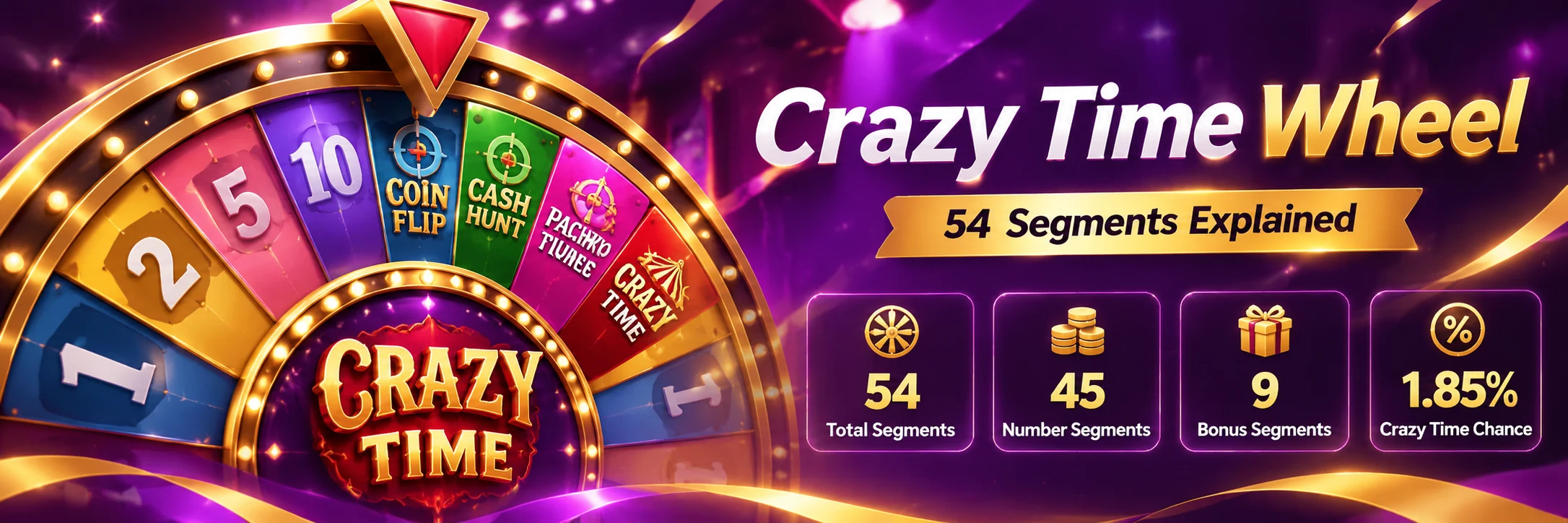
Explore the structure of the Crazy Time wheel, including its numbered segments, four bonus outcomes and the theoretical probability of every result. This breakdown explains the mathematics behind the wheel without confusing probability with prediction.

Crazy Time wheel illustration with 54 segments, numbers and bonus outcomes
Total Segments 54 Eight outcome types
Number Segments 45 83.33% of the wheel
Bonus Segments 9 16.67% of the wheel

How Is the Crazy Time Wheel Divided?

The main wheel contains 54 physical segments, but its eight possible outcomes do not have equal representation. Four outcomes are numbers — 1, 2, 5 and 10 — while the remaining four are Coin Flip, Cash Hunt, Pachinko and the Crazy Time bonus game.

The number 1 occupies 21 segments, making it the most widely represented individual result. Number 2 appears on 13 segments, number 5 on seven and number 10 on four. Together, these numbered outcomes account for 45 of the 54 segments.

The other nine segments belong to bonus games: four for Coin Flip, two each for Cash Hunt and Pachinko, and one for the Crazy Time bonus. This unequal distribution is the starting point for calculating each outcome's theoretical probability.

Crazy Time Wheel Segment Distribution

The proportional chart below compares all eight outcomes. Segment counts and percentages are displayed separately so that the information remains accessible without relying on colour alone.

Proportional representation of the main wheel's eight possible outcomes.
Outcome Segments Chance
Number 1 21 38.89%
Number 2 13 24.07%
Number 5 7 12.96%
Number 10 4 7.41%
Coin Flip 4 7.41%
Cash Hunt 2 3.70%
Pachinko 2 3.70%
Crazy Time 1 1.85%

Crazy Time Wheel Segments and Odds

Each theoretical probability is calculated from the number of matching segments divided by 54. These figures describe main-wheel outcomes only, not the possible multipliers inside individual bonus games.

Wheel Result Segments Probability Type
Number 12138.89%Number
Number 21324.07%Number
Number 5712.96%Number
Number 1047.41%Number
Coin Flip47.41%Bonus
Cash Hunt23.70%Bonus
Pachinko23.70%Bonus
Crazy Time Bonus11.85%Bonus
Total54100%*8 types

*Exact probabilities total 100%. Displayed percentages are rounded to two decimal places.

How to Calculate Wheel Probability

To calculate an outcome's theoretical probability, divide its number of segments by the 54 positions on the main wheel. Multiply the result by 100 to express it as a percentage.

Example — Number 5 7 ÷ 54 × 100 = 12.96%

Number 5 occupies seven of the 54 segments. Its theoretical chance on one spin is approximately 12.96%.

The Crazy Time bonus occupies just one segment. Its individual theoretical probability is therefore 1 ÷ 54, or approximately 1.85%.

A theoretical probability does not establish a schedule for future outcomes. A result with a 12.96% chance is not guaranteed to appear within a fixed number of spins.

Number Segments vs Bonus Segments

Numbered results occupy 45 of the wheel's 54 segments. The four bonus games occupy the remaining nine. This gives number results a combined probability of 83.33%, compared with 16.67% for any bonus outcome.

Number outcomes83.33%
Any bonus outcome16.67%
Crazy Time bonus only1.85%

These values represent the main wheel's physical distribution. They are not the same as RTP. Return to Player also depends on the payout structure, bonus rules and multipliers.

Four Distinct Bonus Features

Crazy Time Bonus Rounds

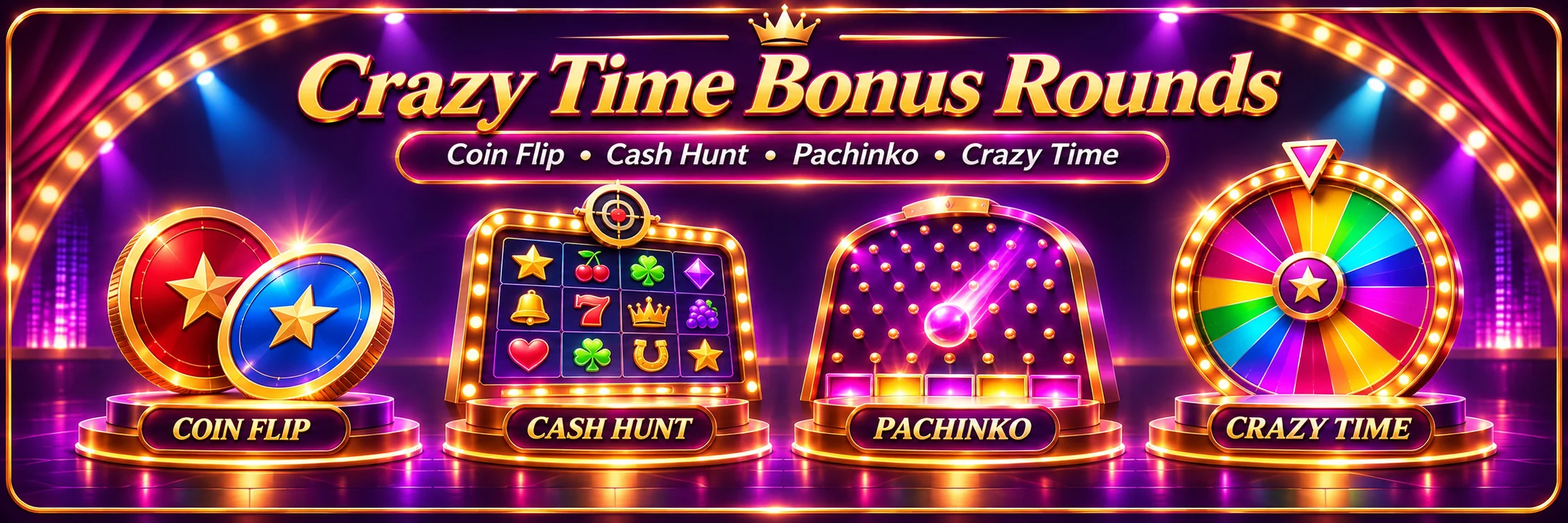
Coin Flip, Cash Hunt, Pachinko and the Crazy Time bonus wheel each use a different mechanism to determine a result. Explore how these four features work, what makes them distinctive and how their multiplier systems differ.

The four Crazy Time bonus games illustrated: Coin Flip, Cash Hunt, Pachinko and the Crazy Time wheel

What Happens During a Bonus Round?

When the main Crazy Time wheel lands on a bonus symbol, the standard wheel sequence transitions into a separate feature. Each feature has its own visual environment, method of determining multipliers and rules for resolving the final outcome.

Coin Flip and Pachinko produce a common result within their respective features. Cash Hunt and the Crazy Time bonus wheel include individual selections, so different participants can receive different results during the same bonus round.

These features should not be confused with casino promotional offers. They are built-in parts of the Crazy Time game itself and operate through the underlying rules of the live game show.

Red & Blue Coin

Coin Flip Bonus

The Coin Flip feature uses a large two-sided coin with red and blue faces. A multiplier is assigned to each side before the flip. Once the coin is tossed, the colour shown by the final result determines the applicable multiplier.

Both multiplier values are visible before the outcome is revealed. This creates a clear contrast between the possible results, but the larger displayed value does not make its colour more likely to appear.

Coin Flip is a shared-result feature. Participants do not select the winning side; the same coin outcome determines the result for those participating in that feature.

The game may also include a Rescue Flip under specific conditions. This additional mechanic is not a standard occurrence on every Coin Flip round and should be distinguished from the ordinary two-colour result.

Interactive Target Selection

Cash Hunt Bonus

Cash Hunt presents a large shooting-gallery-style display containing 108 concealed multiplier positions. The values are assigned behind colourful symbols, but their locations are hidden during the selection stage.

Each participating user can select a target. After the selection period, the hidden values are revealed, and the multiplier associated with the chosen position becomes that person's result.

This is one of the defining differences between Cash Hunt and the shared-result features. Different selections within the same bonus round can reveal different multiplier values.

The symbols are visual covers for concealed results. Their appearance does not provide reliable information about the hidden multiplier, and previous Cash Hunt rounds cannot establish which target will hold a particular value next.

Puck & Pegboard

Pachinko Bonus

Pachinko features a large vertical pegboard with multiplier positions along its lower edge. A puck is released from the top and travels down the board, changing direction as it passes through the pegs.

The landing position determines the feature's result. Unlike Cash Hunt, there is no individual target-selection stage. The same puck-drop sequence establishes the outcome for the feature.

A special Double position may appear among the available results. When the puck reaches Double, the displayed multiplier values are doubled and the process continues with another puck drop.

More than one Double result can occur during an extended sequence. The feature ends when the puck finally reaches a multiplier position. Its visible path does not provide a reliable way to predict the final result in advance.

Virtual Wheel & Three Pointers

Crazy Time Bonus Wheel

The Crazy Time bonus starts when the main 54-segment wheel lands on its dedicated Crazy Time symbol. A separate virtual wheel then appears, containing multiplier positions and special enhancement outcomes.

This bonus has three coloured pointers: blue, green and yellow. Participating users select one pointer, and the segment aligned with that pointer determines their result when the virtual wheel stops.

The virtual wheel can also produce Double and Triple outcomes. These special positions may multiply the displayed values and initiate a further spin according to the feature's rules.

Since different pointers can stop at different positions on the same wheel, participants may receive different outcomes within one Crazy Time bonus.

It is important to separate the probability of activating this bonus from its internal multiplier system. The main wheel contains only one Crazy Time bonus segment, while the virtual bonus wheel uses its own result structure.

How the Four Bonus Rounds Compare

All four features begin with a bonus result on the main wheel, but the way their internal outcomes are determined differs. The comparison below highlights the mechanics and whether individual selections are involved.

Bonus Game Wheel Segments Individual Choice Result Mechanic
Coin Flip 4 No Two-sided coin
Cash Hunt 2 Yes Concealed target selection
Pachinko 2 No Puck and pegboard
Crazy Time 1 Yes Virtual wheel and pointers

Wheel segment counts relate only to the main 54-segment wheel. They should not be interpreted as the probability of particular multipliers occurring within individual bonus games.

Game Mathematics & Statistics

Crazy Time RTP & Odds

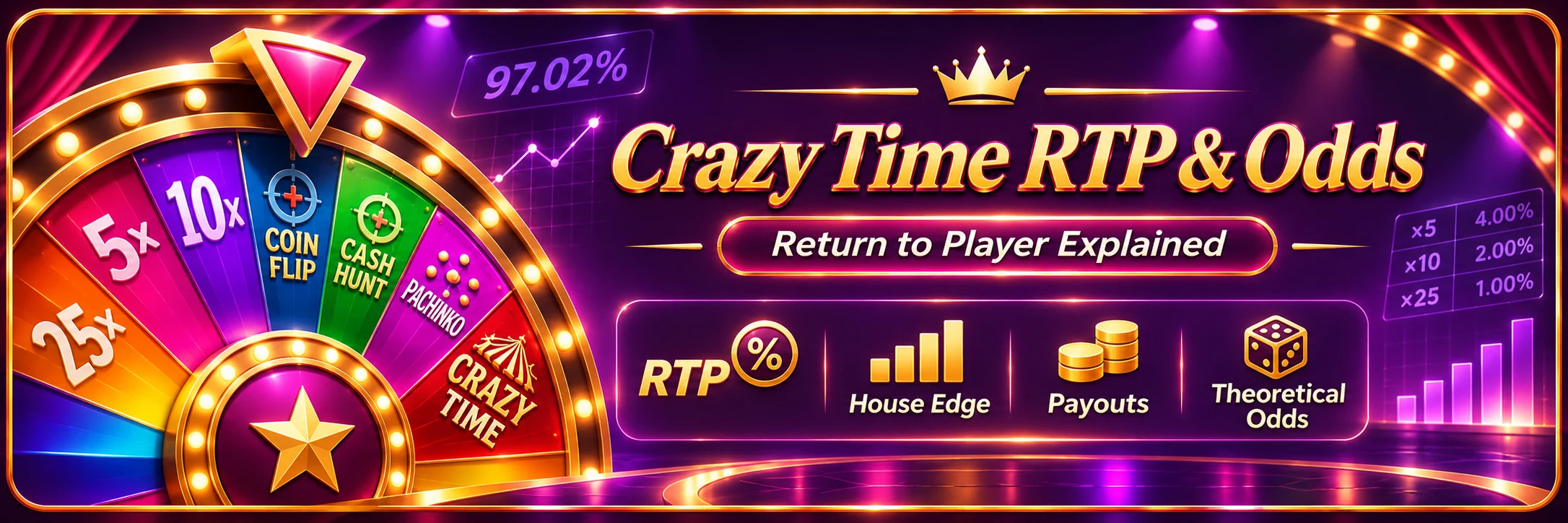
Return to Player, house edge and wheel probability describe different parts of Crazy Time's mathematical model. This guide explains the documented theoretical returns for all eight game options, how the percentages are interpreted and why RTP cannot predict an individual result.

Crazy Time RTP and odds illustration showing the game wheel and mathematical statistics

What Is the RTP of Crazy Time?

Return to Player (RTP) is a theoretical percentage describing how much a game is mathematically designed to return across a very large number of wagers. It is not a statement about what one participant will receive during a particular session.

A documented 2020 Evolution rules table lists theoretical RTP values ranging from 94.33% to 96.08% across the eight Crazy Time selections. Number 1 has the highest listed RTP, while Pachinko has the lowest. These values are historical reference figures, not verification of every current game configuration.

Because each option has its own mathematical return, quoting 96.08% as the guaranteed RTP of the entire game would be misleading. A theoretical return also includes the relevant rules and multiplier mechanics, rather than relying only on the distribution of segments on the main wheel.

Documented theoretical RTP range 94.33%–96.08%
94.33% · Pachinko 96.08% · Number 1

Range illustration only, not a zero-based probability scale. Historical Evolution game-rules reference.

Crazy Time RTP by Game Option

The eight selections have different documented returns. The house edge is calculated by subtracting the RTP from 100%. The following values are reproduced as historical reference data from Evolution's 2020 game-rules table, version 2.2.

Game Option Theoretical RTP House Edge Category
Number 1 96.08% 3.92% Number
Number 2 95.95% 4.05% Number
Number 5 95.78% 4.22% Number
Number 10 95.73% 4.27% Number
Coin Flip 95.70% 4.30% Bonus
Cash Hunt 95.27% 4.73% Bonus
Crazy Time Bonus 94.41% 5.59% Bonus
Pachinko 94.33% 5.67% Bonus

Reference: Evolution and Ezugi Game Rules, version 2.2 (2020). House-edge values are calculated as 100% minus RTP. These historical figures do not confirm the present settings of every game implementation.

Understanding the House Edge

House edge expresses the same mathematical relationship as RTP, viewed from the opposite direction. A 96.08% theoretical return corresponds to a 3.92% house edge.

The chart compares house-edge percentages on a common zero-to-six-percent scale. Longer bars represent a larger theoretical house edge, not a prediction of the next wheel result.

House Edge by Option Historical reference · Common scale: 0% to 6%
Number 1 3.92%
Number 2 4.05%
Number 5 4.22%
Number 10 4.27%
Coin Flip 4.30%
Cash Hunt 4.73%
Crazy Time 5.59%
Pachinko 5.67%

Each bar begins at zero. The numerical value remains visible so the comparison does not rely on bar length or colour alone.

How Is House Edge Calculated?

House edge is the difference between a theoretical full return of 100% and the published RTP for a particular game option. It is an expected long-run mathematical margin, not a fixed deduction taken from every individual result.

House Edge Formula 100% − RTP = House Edge

The result is expressed as a percentage of the theoretical amount wagered over a large sample.

Example: Number 1 100% − 96.08% = 3.92%

The documented Number 1 RTP corresponds to a theoretical house edge of 3.92%.

These percentages should not be mistaken for a guaranteed loss or return over a small number of rounds. Actual short-term outcomes may vary considerably because the game is chance-based.

RTP vs Crazy Time Wheel Odds

Wheel odds describe the theoretical probability of a particular segment type being selected. RTP instead describes the expected long-run return associated with a game option after its payout rules and multiplier mechanics are taken into account.

Wheel Probability

Number 1 occupies 21 of the 54 main-wheel segments, representing approximately 38.89% of the physical wheel.

Return to Player

The historically documented Number 1 RTP is 96.08%. This value accounts for the applicable mathematical payout model.

House Edge

Subtracting the 96.08% theoretical return from 100% gives a 3.92% house edge.

An option appearing more frequently on the wheel does not automatically have a higher RTP. Frequency and payout size are different components of the game's mathematical structure.

How Do Top Slot and Bonus Multipliers Affect RTP?

Crazy Time contains random multiplier features that can affect the value of qualifying outcomes. These include the Top Slot mechanism on the main wheel and the separate multiplier structures used by the four bonus games.

Published theoretical RTP calculations are based on the applicable game rules and mathematical model. They should not be recalculated simply by multiplying the frequency of a wheel segment by its base numerical payout.

A multiplier represents a possible payout enhancement under defined conditions. Its presence does not mean the corresponding outcome is more likely to occur, nor does it establish a dependable strategy for predicting future results.

Does RTP Predict Actual Results?

RTP is a long-run theoretical measure. It does not mean that a game will return the stated percentage over ten spins, one hundred spins or any particular individual session.

Live game shows with variable bonus multipliers can produce uneven results over shorter periods. An occasional large multiplier or a sequence of ordinary wheel outcomes should not be interpreted as evidence that the published mathematical return has changed.

Historical spin records can describe what has already occurred, but they cannot reliably establish the next result. The correct use of RTP data is to understand theoretical game behaviour, not to forecast individual outcomes.

Understanding Recorded Outcomes

Crazy Time Results & History

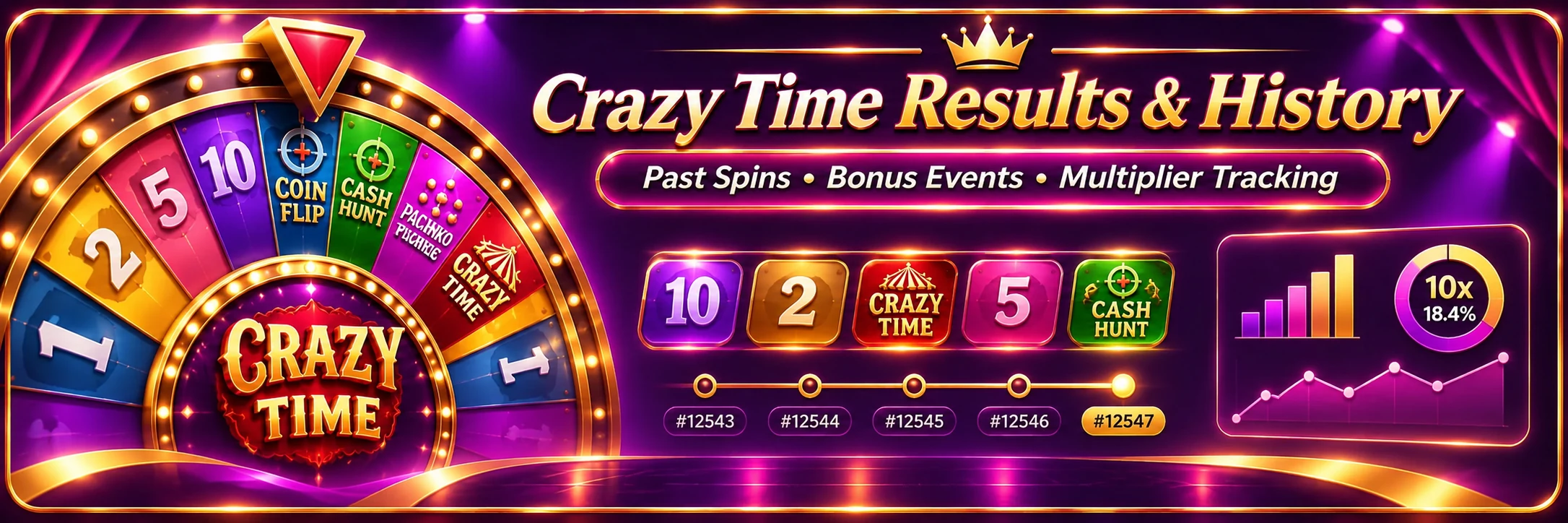
Crazy Time result histories can reveal which wheel segments appeared in previous rounds, when bonus features were triggered and how recorded multipliers were displayed. Learn how to interpret past spins, understand result statistics and avoid confusing historical patterns with future predictions.

Crazy Time results and history illustration showing wheel outcomes, previous spins and statistical tracking

What Do Crazy Time Results Show?

A Crazy Time result record usually identifies the outcome of a completed main-wheel spin. That outcome may be one of the four numbers — 1, 2, 5 or 10 — or one of the four bonus features: Coin Flip, Cash Hunt, Pachinko and Crazy Time.

More detailed histories may include a round timestamp, the Top Slot selection, whether the selected outcome matched the main wheel and any resulting multiplier. When a bonus feature occurs, additional information may be needed to describe how its result was determined.

Historical results are records, not forecasts. They help explain what happened in previous rounds, but they do not establish a dependable method for predicting what will happen on the next spin.

How to Read Crazy Time Spin History

A result history is easier to interpret when each piece of information is read separately. The wheel result identifies the segment that stopped beneath the pointer, while Top Slot information describes a separate multiplier feature associated with that round.

Example of Five Recorded Outcomes Illustrative Sequence · Not Live Data
  1. 01 10 Number
  2. 02 2 Number
  3. 03 Coin Flip Bonus
  4. 04 5 Number
  5. 05 Cash Hunt Bonus

This fictional sequence demonstrates how historical outcomes may be displayed. It does not represent recent or verified Crazy Time spins.

Understanding a Crazy Time Results Table

A detailed history separates the recorded result from supplementary information such as the Top Slot multiplier and bonus type. This distinction is important because a selected Top Slot outcome does not always match the final wheel segment.

Illustrative examples only — not actual spin records
Round Wheel Result Top Slot Top Slot Match Outcome Type
Example A Number 2 2 · 3× Yes Number
Example B Number 5 1 · 2× No Number
Example C Coin Flip 10 · 5× No Bonus
Example D Cash Hunt 2 · 3× No Bonus

The examples demonstrate the relationship between a main-wheel result and a possible Top Slot selection. They are fictional, contain no timestamps and are not a live data feed.

Understanding Crazy Time Bonus History

Bonus history records may identify when a bonus feature was triggered on the main wheel. However, the main-wheel result alone does not always describe the complete outcome of the bonus itself.

Coin Flip has a shared colour-based result, while Pachinko follows a puck-drop sequence. Cash Hunt involves a concealed target selection, and the Crazy Time bonus wheel uses separate coloured pointers. These differences affect what a detailed bonus history can meaningfully record.

Coin Flip

Records may describe the winning colour and resulting multiplier.

Cash Hunt

Individual target choices can produce different bonus outcomes.

Pachinko

Records may include the final multiplier and any Double events.

Crazy Time Bonus

The selected pointer and bonus-wheel outcome can affect the recorded result.

Crazy Time Statistics: Frequency and Streaks

Statistics derived from historical results describe what occurred within a particular sample of spins. A frequency percentage is calculated by dividing the number of appearances of an outcome by the total number of recorded spins.

A streak is a consecutive sequence of similar results, while a gap describes the number of rounds between occurrences of a selected outcome. Neither measurement changes the fixed segment distribution of the main wheel.

Example: Observed Bonus Frequency

If a hypothetical sample of 100 spins contains 19 bonus outcomes, the observed bonus frequency is 19%. The theoretical main-wheel probability of any bonus remains 9 ÷ 54, or approximately 16.67%. The two figures need not be identical in a finite sample.

The size and source of a dataset matter when interpreting historical statistics. A limited sample can fluctuate noticeably around the theoretical probabilities without indicating a change in the underlying rules.

Comparing Observed Frequency With Theoretical Odds

The chart below uses the hypothetical 100-spin example to demonstrate the difference between a measured sample and the theoretical wheel distribution. It is not based on collected live game results.

Bonus Frequency Comparison

The bars use the same 0–100% scale. Percentage values are also shown as text.

Hypothetical observed frequency
19.00%
Theoretical bonus probability
16.67%

Can Previous Crazy Time Results Predict Future Spins?

Historical results cannot provide a reliable prediction of the next Crazy Time spin. Under the game's theoretical wheel model, an independently determined result does not become more or less likely merely because similar outcomes recently occurred.

For example, a long sequence without the Crazy Time bonus does not mean that its single segment is due to appear. Likewise, several numbered outcomes in succession do not guarantee that the next result will be a bonus.

Treating past outcomes as a schedule for future results is a common statistical error known as the gambler's fallacy. Result histories are useful for understanding recorded events and calculating observed frequencies, but they do not remove the uncertainty of future spins.

Questions & Answers

Crazy Time FAQ

Find straightforward answers to common questions about Crazy Time, including game rules, wheel mechanics, bonus features, RTP and historical results. Each answer focuses on the essential facts without unnecessary repetition.

Crazy Time frequently asked questions banner featuring the game wheel and game show design

Everything You Need to Know

From the structure of the 54-segment wheel to bonus multipliers and game statistics, these answers clarify the details that commonly cause confusion. The questions are grouped by topic so you can find relevant information without searching through the entire guide.

12 Essential answers
01

Game Basics & Rules

What is Crazy Time by Evolution?

Crazy Time is a live game show developed by Evolution. It combines a physical money wheel with four numbered outcomes and four interactive or chance-based bonus features.

A presenter hosts the game in a studio environment. Each round concludes with a main-wheel result, which may produce a numbered outcome or trigger a separate bonus feature.

How many segments are on the main wheel?

The main Crazy Time wheel contains 54 segments. Of those, 45 are numbered segments and nine represent bonus outcomes.

Number 1 occupies 21 segments, number 2 has 13, number 5 has seven and number 10 has four. The remaining segments are assigned to the four bonus games.

How does the Top Slot feature work?

Top Slot is a separate multiplier feature that selects an eligible outcome and a multiplier before the main result is determined.

The multiplier applies only when the wheel lands on the matching outcome, according to the game's rules. It does not influence or guarantee the final stopping position.

02

Bonus Games & Features

What are the four Crazy Time bonus games?

The four bonus games are Coin Flip, Cash Hunt, Pachinko and Crazy Time. Each uses a different mechanism to determine a multiplier.

Coin Flip uses a two-sided coin, Cash Hunt involves concealed targets, Pachinko uses a puck-drop board and Crazy Time features a separate virtual bonus wheel.

Which Crazy Time bonus has the fewest main-wheel segments?

The Crazy Time bonus has only one segment on the 54-segment main wheel, giving it a theoretical probability of approximately 1.85% per main-wheel spin.

This describes the chance of activating the feature, not the probability of a particular multiplier appearing inside the bonus itself.

Do all bonus participants receive the same outcome?

Not necessarily. Coin Flip and Pachinko generally have a shared feature result. Cash Hunt and the Crazy Time bonus wheel include individual selections.

Consequently, different participants can receive different results in the same Cash Hunt or Crazy Time bonus round, depending on their selected target or pointer.

03

RTP, Odds & Multipliers

What is the RTP of Crazy Time?

Crazy Time has different theoretical RTP values for its eight game options. A historical Evolution rules table from 2020 lists values between 94.33% and 96.08%.

RTP is a long-term mathematical measure. It does not guarantee any particular return during an individual session, and historical values may not describe every current game configuration.

Are wheel probability and RTP the same?

No. Wheel probability measures how likely the wheel is to stop on an outcome, based on its segment distribution.

RTP describes the expected long-term return under the game's payout rules, including applicable multiplier mechanics. A frequently occurring result does not automatically have the highest RTP.

Can Crazy Time multipliers guarantee a particular payout?

No. Multipliers only apply when the relevant outcome and feature conditions are satisfied.

A high displayed multiplier represents a possible result, not a promise that it will occur. It should not be confused with the probability of the corresponding wheel segment appearing.

04

History, Demo & India

Can previous results predict the next Crazy Time spin?

No. Past outcomes are useful for recording historical events, but they cannot reliably predict future spins.

A long period without a particular result does not mean it is due to appear. This assumption is known as the gambler's fallacy.

Can Crazy Time be watched without placing a wager?

Some services may offer a spectator experience, demonstrations or recorded gameplay footage, depending on their available features and regional rules.

Free viewing should not be assumed to be available on every platform. This guide explains the game mechanics without requiring participation in real-money gaming.

Is real-money Crazy Time gaming legal in India?

India introduced the Promotion and Regulation of Online Gaming Act, 2025, which prohibits online money games under its applicable provisions.

Legal requirements and enforcement must be checked against current official regulations. This website provides educational information about Crazy Time and does not facilitate real-money gaming.

Mobile Experience Guide

Crazy Time Mobile, App & Demo

Learn how Crazy Time is presented on mobile devices, what to know about Android and iPhone compatibility, and how browser-based access differs from a dedicated app. This guide also explains demo availability, download verification and important software safety checks.

Crazy Time mobile guide featuring a smartphone, game wheel, Android and iPhone information

Can You Access Crazy Time on Mobile?

Crazy Time uses a live game-show format with a colourful wheel, animated bonus features and an interface designed to display game information in real time. Mobile access, where supported, adapts these elements to smaller screens.

A mobile interface typically prioritises the live video, main wheel result and essential controls. On smaller devices, additional information may be arranged in collapsible panels or compact sections instead of the wider desktop layout.

Browser compatibility does not necessarily mean that a separate official app exists. Access and viewing options depend on the platform, the device and any applicable regional restrictions.

Android

Browser-based viewing and platform compatibility depend on the device and service.

iPhone

Mobile-browser layouts may adapt to iOS screen sizes and touch interaction.

Understanding the Crazy Time Mobile Experience

Mobile design changes how the game is displayed, but not the underlying purpose of its main components. Three interface elements are especially important when evaluating a mobile version.

01 / DISPLAY

Live Wheel Visibility

The main video area should make the wheel, pointer and current result readable without unnecessary interface elements obstructing the view.

02 / INTERACTION

Touch-Friendly Controls

Important controls need sufficient spacing and legible labels. Small touch targets can make navigation difficult, particularly on compact smartphone screens.

03 / PERFORMANCE

Stable Viewing

Video streaming quality depends on the device, connection and platform. A stable connection generally provides a more consistent experience than one affected by frequent interruptions.

Mobile Browser vs App vs APK Download

These access methods are not interchangeable. Understanding their differences is especially important when a website advertises a download without clearly identifying the software publisher.

Access Method Installation Important Consideration
Mobile Browser Usually not required Availability depends on the platform and regional access rules.
Verified App Required Confirm the publisher, listing and permissions before installation.
Third-Party APK Manual installation Unknown files can expose devices to security and privacy risks.

Crazy Time Demo and Free Viewing

A demo or spectator mode, where available, can help users understand the game interface without real-money participation. Such access may include viewing the main wheel, observing the presenter or learning how bonus features appear.

Demo availability is not universal. Recorded demonstrations and interactive free-play versions should also be distinguished from an authentic live game feed.

Educational viewing can explain the sequence of a round, but a demonstration does not provide dependable predictions of real outcomes.

App Download and Software Safety

A Crazy Time download should never be assumed genuine solely because a website uses official-looking game artwork. Publisher details, package identity, distribution source and permission requests should be checked before installing any software.

The game can be presented through an operator's platform without requiring a standalone app published by Evolution. Therefore, a branded download link is not automatically evidence of an official Crazy Time application.

Avoid unknown installation files and services requesting unnecessary access to personal information, financial details or device settings.

Scroll to Top